Showing posts with label Major Chords. Show all posts

Saturday, August 6, 2011

Dylan Kay Lesson #5 - II V I in F Major

chordadayXX


[From Dylan Kay]
Here are two examples of the superimpositions we have been studying. You may want to record the bass notes G, C and F to play these superimposed chords over, or even better get someone else to play the bass notes while you play the chords.

Also, try just playing the top 3 notes of each voicing…

Try and use the other voicings from the previous lessons to come up with some more II V I superimpositions of your own. You could also experiment with playing all the given voicings on strings 6,5,3,2.


[From Az]
And this concludes our five part lesson series featuring British guitarist-educator Dylan Kay! Stay tuned next week for new lessons from me!

If you're just joining us here at A Chord A Day, here are links to the other four lessons in this five-part series by Mr. Kay:

Lesson #1: Drop 2 + 4 voicings
Lesson #2: BbMaj7
Lesson #3: Emaj7b5
Lesson #4 : Am7

Enjoy!

rss feed
Subscribe via Email

Friday, August 5, 2011

Dylan Kay Lesson #4 - Drop 2&4 voicings for Am7

DK4


[From Dylan Kay]
Step three is to look at Drop 2 & 4 voicings for Am7. These will be superimposed over the Famj7 chord to create an Fmaj9 sound. (Am7 is A, C, E, G – the 3, 5, 7, 9 of the Fmaj7 chord).

Related links: Dylan Kay's Official Website

Previous: Lesson #3 - Emaj7b5
Next: Lesson #5 - II V I in F Major


rss feed
Subscribe via Email

Wednesday, August 3, 2011

Dylan Kay Lesson #3: Drop 2&4 voicings for Emaj7b5

chordadayXX


[From Dylan Kay]

Step two is to look at Drop 2 & 4 voicings for Emaj7b5. These will be superimposed over the C7 chord to create a C7#5#9 sound. (Emaj7b5 contains the notes E, G#, Bb, D# – these are the 3, #5, b7, #9 of the C7 chord).

Related links: Dylan Kay's Official Website

Previous : Lesson #2 - BbMaj7
Next : Lesson #4 - Am7


rss feed
Subscribe via Email

Tuesday, August 2, 2011

Dylan Kay Lesson #2: Drop 2&4 Voicings for BbMaj7

chordadayXX


[From Dylan Kay]
By the end of this series of lessons, we will have some great-sounding extended voicings for a II V I in the key of F major (Gm7 - C7 - Fmaj7).
** Warning – some of these voicings involve quite large stretches – be careful! **

Step one is to look at Drop 2 & 4 voicings for Bbmaj7. These will be superimposed over the Gm7 chord to create a Gm9 sound. (This works because the notes of Bbmaj7 are Bb, D, F, A – these are the b3, 5, b7 and 9 of the Gm chord).

Related links: Dylan Kay's Official Website


Yesterday : Lesson #1 - Drop 2 & 4 Voicings
Tomorrow : Lesson #3 - EMaj7b5


rss feed
Subscribe via Email

Monday, August 1, 2011

Dylan Kay Lesson #1: Drop 2&4 Voicings

dylankay1


[From Az]
This week, I'm very happy to present a series of lesson by British guitarist-educator Dylan Kay. I talked to Dylan about a month ago about the possibility of him contributing a few lessons and was happy when he sent me a five-part lesson on Drop 2 & 4 voicings! I'm a fan of these sounds myself so when I received them, I too started practicing them! I hope you will enjoy the lessons too!

[From Dylan Kay]
The objective of this short series of lessons is to derive some great-sounding extended voicings for a II V I in the key of F major (Gm7 - C7 - Fmaj7). We are going to superimpose Drop 2 & 4 voicings to do this.

So first of all, “what’s a Drop 2 & 4 voicing?” Well, these are found by taking close-voiced inversions and dropping the 2nd and 4th notes from the top by an octave. (Similar to constructing Drop 2 voicings).

Shown above are root position and first inversion voicings for a Cmaj7 chord. Check out the notation to see how the Drop 2 & 4 voicings come from close voicings. You will notice you end up with 4 notes spread across 5 strings, “split” in the middle.

Related links: Dylan Kay's Official Website

Tomorrow : Lesson #2 - BbMaj7

rss feed
Subscribe via Email
If you've enjoyed this lesson, like it and share it with your friends!

Wednesday, May 14, 2008

Chord #82 - CMaj7

chordaday82

Today's chord is a useful 3-note voicing. Piano players sometimes refer to these kinds of voicings as shell voicings.

In the musical example, I played an arpeggiated version of the chord with an approach note before playing the 7th. This is way of embelishing chords that I've seen guitarists like Jon Damian, Howard Alden and Martin Taylor use in their comping. The progression I played is CMaj7-EbMaj7-AbMaj7-DbMaj7.

Enjoy!

rss feed
Subscribe via Email

Saturday, May 10, 2008

Chord #78 - GMaj6(9) no 3rd

chordaday78

This is a nice major chord voicing that I can see myself using a lot in pop settings.

For the musical example, I played an embelished GMaj7-Amin7-Bmin7-CMaj7 progression.

Enjoy!

rss feed
Subscribe via Email

Saturday, May 3, 2008

Chord #71 - A

chordaday71

Today I played a simple A Major chord!

The fingering I chose however makes this a useful movable voicing.

In the musical example, I played a I-IV-V-IV progression over an A bass pedal. This is one way of using today's voicing in a rock/pop context. An interesting rhythmic device that I used here is a polyrhythm between the bass and chords. This is a 3 over 2 pattern which is very common in African music.

Enjoy!

rss feed
Subscribe via Email

Friday, May 2, 2008

Chord #70 - G6 (no 3rd)

chordaday70

This is a sparse voicing that is useful to create contrast compared to bigger voicings. I might use this chord for one section of a song (perhaps an earlier verse) before using a more elaborate voicing later.

Again, because there is no 3rd in the voicing, this can be used for Major, Dominant and Minor Chords.

In the musical example I used it as a replacement for a G Major chord. Here, I played a simple pattern between the I and IV chords in G.

Enjoy!

rss feed
Subscribe via Email

Thursday, May 1, 2008

Chord #69 - Dsus2(addb6)

chordaday69

Today's chord can also be called a BbMaj7(b5)/D but I think the name I chose is more reflective of how I used it in the accompanying example. As this voicing is basically a sus chord with an added b6, it can be used for Major, Dominant and Minor (Aeolian) situations.

In the musical example, I played an accompaniment pattern that could be used behind a vocal line. I think I was inspired by the kind of music I heard recently in Tim Burton's movie, Sweeney Todd.

Enjoy!

rss feed
Subscribe via Email

Wednesday, April 30, 2008

Chord #68 - CMaj7(no 3rd)

chordaday68

Today's chord is similar to Chord #30 and Chord #65. In today's voicing, I avoided the 3rd of the chord therefore making it usable for both CMajor7 and Cminor(Maj7).

In the musical example, I played a repeating 3-3-2 picking pattern which is a very common rhythmic device particularly in rock (think of the piano part for the Coldplay song - Clocks). It is also used a lot in the music of New Orleans.

The chord progression implied is CMaj7-EbMaj7-BbMaj7-DbMaj7. In the jazz world, using one chord quality throughout a section of a song is referred to as using a 'constant structure'. It is also a great compositional device that is very friendly to guitarists.

Enjoy!

rss feed
Subscribe via Email

Monday, April 28, 2008

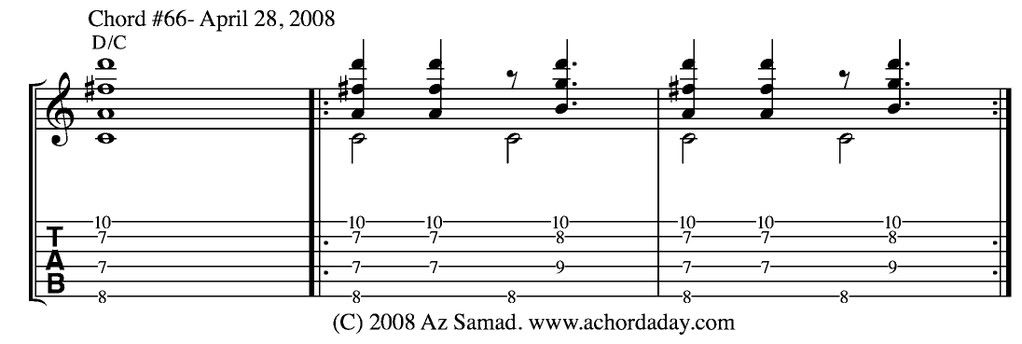
Chord #66 -D/C

chordaday66

Today's chord is a hybrid voicing. It contains an open voiced D Major triad over a C bass note.

For the musical example, I played a simple bossa nova vamp using today's chord and G/C chord voiced in a similar manner.

This could be used for an introduction for a Major Key Bossa Nova piece. In fact, one of the songs that today's chord reminds me of is Aquas De Marco (Waters of March) - a composition of Antonio Carlos Jobim.

Enjoy!

rss feed
Subscribe via Email

Monday, April 21, 2008

Chord #59 - CMaj7/F

chordaday59

Today's chord is sometimes called a hybrid voicing which is a chord over a bass note that is a non-chord-tone. In this case, this is a close Major7th voicing over its 4th.

For the musical example, I played a fingerpicking pattern that looks more complicated on paper than it is actually to play. Basically, there is a repetitive root-fifth bass pattern that is played by the thumb (or pick) and the rest is with the other right hand fingers (i,m,a). I used my 2nd and 4th fingers to finger the F and C note and my 1st finger to play the D note on the 3rd string.

Enjoy!

rss feed
Subscribe via Email

Saturday, April 19, 2008

Chord #57 - CMaj(add2)

chordaday57

This chord could be called a Cadd9 but I figured because the 9th is in the lower octave, this uncommon name might be most precise. (I also thought of Csus2(add10) but that sounded even more confusing!)

This voicing is also very similar to Chord #30 - in fact I just took one note out from Chord #30 to get today's chord.

The musical example is a simple I-IV-V progression that has been embellished using open strings.

Enjoy!

rss feed
Subscribe via Email

Friday, April 18, 2008

Chord #56 - BMaj7

chordaday56

Today's chord uses an open string in addition to a standard Drop-Two guitar chord voicing to create a piano-type voicing.

For the musical example, I used similar voicings (on the lower four strings) and the open B string for added color. The comping pattern is typical of 90's R&B ballads. It can also be an accompaniment for a guitar solo or a guitar ballad.

Enjoy!

rss feed
Subscribe via Email

Tuesday, April 15, 2008

Chord #53 - AMaj7/C#

chordaday53

This chord has doubled 3rd in the voicing.

The musical example is a simple triplet pattern alternating the bass notes.

Enjoy!

rss feed
Subscribe via Email
Monday, April 14, 2008

Chord #52 - CMaj7(#11)no3rd

chordaday52

Today's chord is a useful C Major voicing. It uses two fretted notes (I use my 1st and 3rd fingers to play it but you can use any two finger combination depending on where you want the chord to lead to.)

For the musical example, I played a CMaj7 to GMaj7 chord vamp. I can imagine using this as a singer-songwriter pop song accompaniment part. It can also be used as a vamp to solo in C Lydian.

Enjoy!

rss feed
Subscribe via Email

Saturday, April 12, 2008

Chord #50 - G6(#11) no 3rd

chordaday50

Today's chord can be used for multiple settings. Although I initially heard it as a Major Lydian voicing, it can also be used as both a dominant chord and a minor chord voicing.

In my musical example, the chord progression outlined is in G Dorian(#4), a mode of D Harmonic Minor. In this case, today's voicing actually functions as the tonic chord for this progression (G6(#11)no 3rd - Bbmin(add#11) - A).

I also kept two common tones throughout the different chords - the E natural and C#(Db).

Enjoy!

rss feed
Subscribe via Email

Wednesday, April 9, 2008

Chord #47 - E+6(9#11)

chordaday47

Today's chord is a stretchy chord - which means I played it with the guitar neck facing toward the ceiling (vertical). I would suggest warming up before attempting this voicing and to always exercise care and caution.

In the words of Mick Goodrick - "No pain is the way to go" or better yet, no hint of pain at all. If you hands are uncomfortable, try this voicing with just the top 4 strings.

For the musical example, I played the chord as a funk-style arpeggio phrase mixing up muted notes and notes that were left ringing (the 16th note line on the fourth beat of the first bar. An alternative fingering for this phrase would be playing the first 3 fretted notes on the 3rd and 4th string and then grabbing the chord shape in the last beat of the first bar.

Enjoy!

rss feed
Subscribe via Email

Tuesday, April 8, 2008

Chord #46 - C+(add#11)

chordaday46

Today's chord could be used for both a Major or Dominant chord. I hear it more as a major chord.

In the musical example, I played a chord melody phrase that was inspired by Kurt Rosenwinkel's solo guitar playing. The last chord in the example is an EMaj7(#9).

Enjoy!

rss feed
Subscribe via Email